
Here's something that keeps most content creators up at night: they spend two hours filming the perfect Reel, editing it until their eyes hurt, adding the exact right music, and then... nobody watches it past the first three seconds.
It's like cooking a five-course dinner, having people walk into your house, smelling the amazing food, and immediately leaving before tasting anything. The problem isn't the meal. It's the smell that greets them at the door.
That's what a hook is. It's the first smell. It's the handshake. It's the moment someone decides whether your video is worth their time or if they'll just keep scrolling to the next thing.
Instagram just revealed something in January 2025 that changed the game completely. They started tracking a new metric—how many people watch your Reel past the first 3 seconds. Not a week later, creators everywhere started obsessing over it. Why? Because that number is everything. It determines whether Instagram's algorithm is going to push your content to hundreds of thousands of people or bury it in the digital graveyard.
Think about this: Instagram Reels get watched 140 billion times every single day across Instagram and Facebook combined. That's an absolutely insane amount of eyeballs. But only 20.7% of creators are actually posting Reels regularly. That means there's an enormous opportunity for anyone willing to understand how this actually works.
The truth is, hooking someone on Instagram in 2026 isn't magic. It's not luck. It's a predictable science based on how human brains work. And once you understand the science, you can start creating content that stops people mid-scroll, every single time. Tools like AutoShorts can help you apply these hook principles automatically when repurposing long-form content into viral Reels.
What Exactly is a Reel Hook?
If you asked ten different creators what a "hook" is, you'd probably get ten different answers. Some would say it's a catchy opening line. Others would say it's a shocking visual. Someone else might tell you it's that moment when the music drops.
But the real definition is simpler and more powerful than all of that.
A Reel hook is anything—visual, audio, or verbal—that makes your brain say "wait, I need to see what happens next." That's it. It's the element that transforms your Reel from background noise into something that literally stops the scroll.
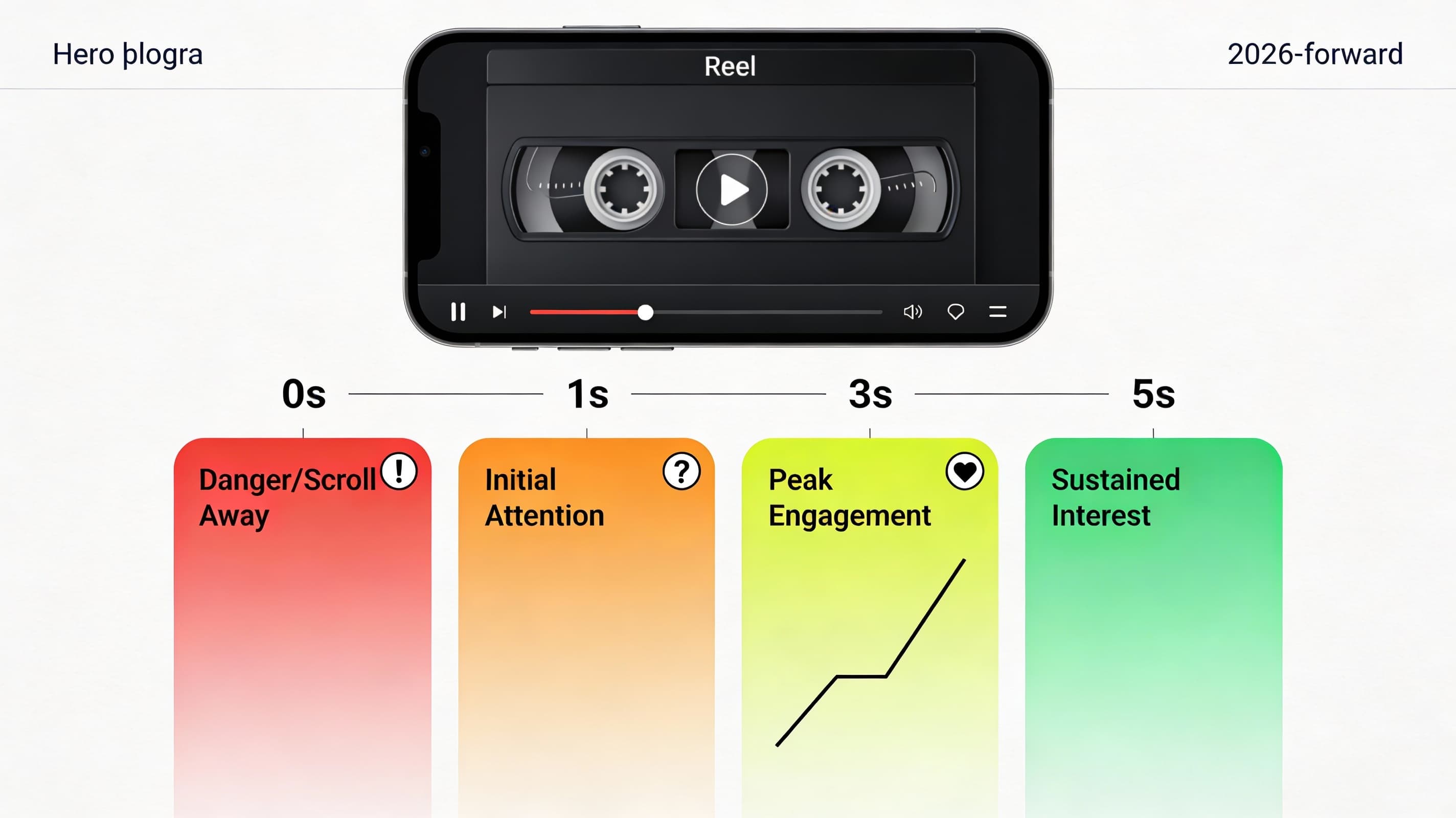
The first 3 seconds determine whether your Reel gets pushed to thousands or buried by the algorithm
Your brain is built to notice change, novelty, and things that don't make sense yet. When something is missing, your brain gets uncomfortable. It wants to fill the gap. A good hook exploits this feeling.
Imagine scrolling through Instagram and seeing text that reads: "This one mistake is costing you..." and then the text cuts off. Your brain doesn't like that. Your brain wants to know what the mistake is. So you watch. You have to. It's not a choice—it's how your neurology works.
The Critical Window
A hook happens in the first 1.5 to 3 seconds of your video. That's the window. After 3 seconds, the algorithm has already started deciding whether to show your video to more people or bench it. If you haven't grabbed attention by then, you're playing from behind for the rest of the Reel.
Research shows that videos with strong hooks in the first 3 seconds see up to 70% higher retention rates. That's not a small difference. That's the difference between going viral and disappearing.
The Psychology Behind Hooks: Why Your Audience's Brain Can't Look Away
Here's something wild that neuroscientists have discovered: your audience isn't scrolling through Instagram rationally. They're not going through a checklist of videos deciding which ones to watch. Instead, they're operating on pure emotion and automatic responses built into their brains millions of years ago.
Understanding these automatic responses is the cheat code to creating hooks that work every single time.
The Curiosity Gap: Loewenstein's Theory of Curiosity
Imagine this: you're walking past a closed door, and you hear your friends laughing inside. You can hear it but can't see what's funny. What happens? You want to open the door. Your brain hates incomplete information.
This is called the Curiosity Gap, and it's rooted in something a researcher named George Loewenstein discovered decades ago. When there's a difference between what you know and what you want to know, your brain becomes uncomfortable. It creates tension. And to relieve that tension, you have to fill in the missing information.
Examples of Curiosity Gap Hooks
- "This one mistake is costing you $10,000 a year..."
- "Wait until you see step three..."
- "She said yes, but here's what happened next..."
Each of these creates a gap. Your brain knows something is coming, but doesn't know what. So it forces you to watch.
Emotional Arousal: Why Feelings Matter More Than Facts
Here's something that might surprise you: facts don't go viral. Feelings do.
Research on viral content shows that videos and posts that trigger high-arousal emotions—whether positive (awe, excitement, joy, inspiration) or negative (anger, fear, shock)—get shared way more often than neutral content. But here's the important part: positive emotions actually drive more shares than negative ones. People like spreading joy more than spreading outrage.
When you open a Reel with something that makes the viewer feel something strong in the first 3 seconds, two things happen:
1. Attention Narrows
The viewer's brain is in "alert mode" and less likely to scroll away.
2. Psychological Reward
If the video delivers on that emotion, it creates a psychological reward that makes them want to share it with others.
This is why the best hooks don't just provide information—they provide feelings.
The Zeigarnik Effect: Why Unfinished Stories Haunt Us
Ever notice how you can't forget a story that was left hanging, but you immediately forget a story that wrapped up perfectly? That's the Zeigarnik Effect.
Our brains remember unfinished tasks better than finished ones. It's why cliffhangers work. It's why teasers work. It's why you can't stop thinking about that comment someone made during a conversation.
When you start a Reel with something unfinished, your viewer's brain latches onto it and won't let go until the story is resolved.
The 3-8-12 Rule: The Science of Psychological Commitment
This is possibly the most important framework for Reel creators in 2026.
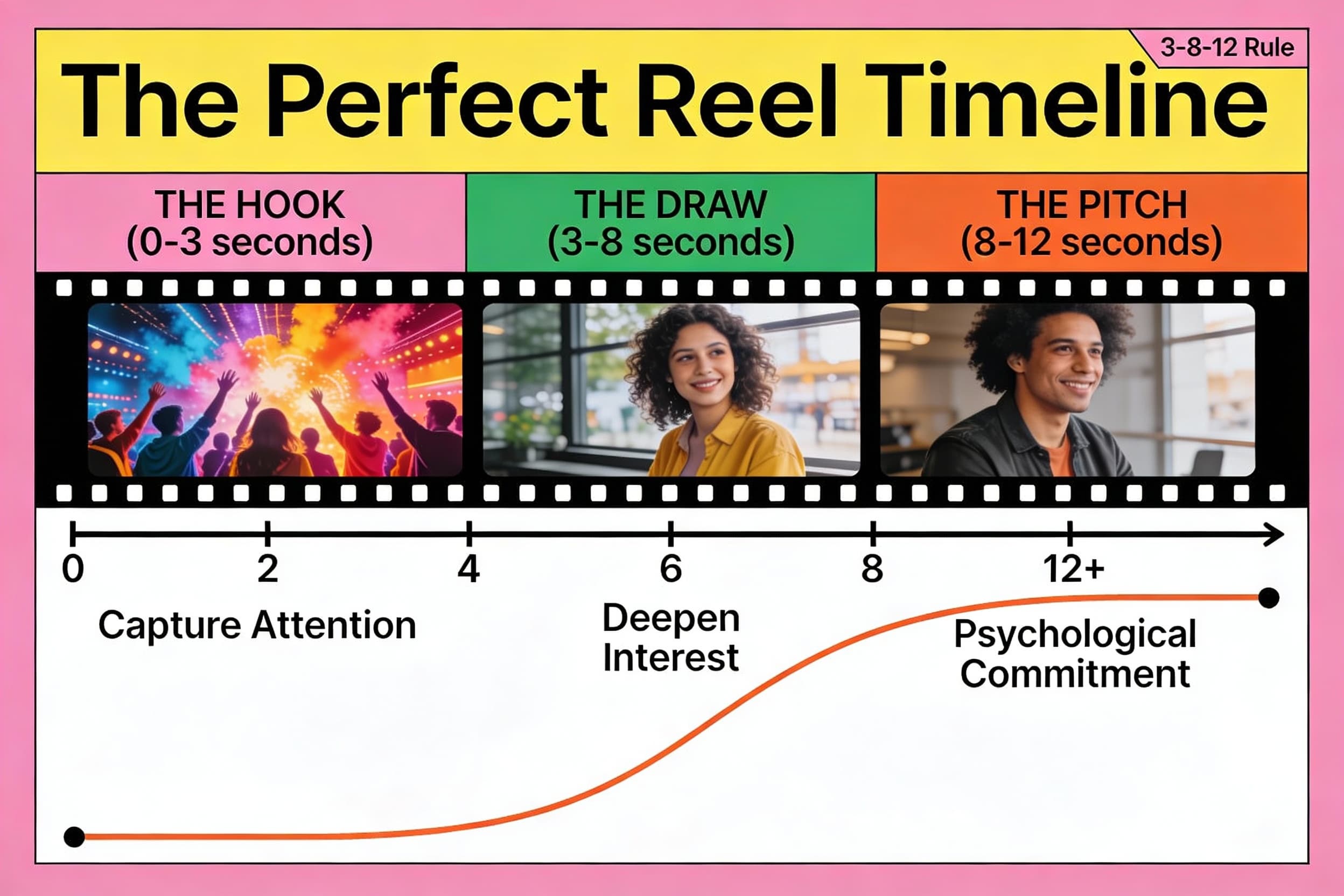
The 3-8-12 Rule: Hook, Draw, and Pitch—three psychological stages that convert casual viewers to engaged fans
Research shows that viewers go through three psychological stages while watching video content:
The Hook (0-3 seconds)
You're capturing attention and creating conscious engagement. At this point, your viewer is deciding whether to scroll or stay.
The Draw (3-8 seconds)
You're deepening interest. The hook did its job, and now you're making them care. You're building curiosity or emotional investment.
The Pitch (8-12 seconds)
This is where psychological commitment happens. By 12 seconds, most viewers have passed the average human attention span for visual media. If they've made it this far, they're likely to finish the video.
Why This Matters
Once your viewer crosses into that 12-second mark with you, they've invested mental energy. Quitting now feels like a waste. So they keep watching. This is why short, punchy Reels sometimes underperform, and why a well-structured 30-second Reel can crush it. It's not about length—it's about creating these three stages of engagement.
The 7 Hook Types That Actually Stop the Scroll
Not all hooks are created equal. Different hook types trigger different parts of your viewer's brain. Understanding which one to use for your specific content is the difference between okay Reels and viral ones.
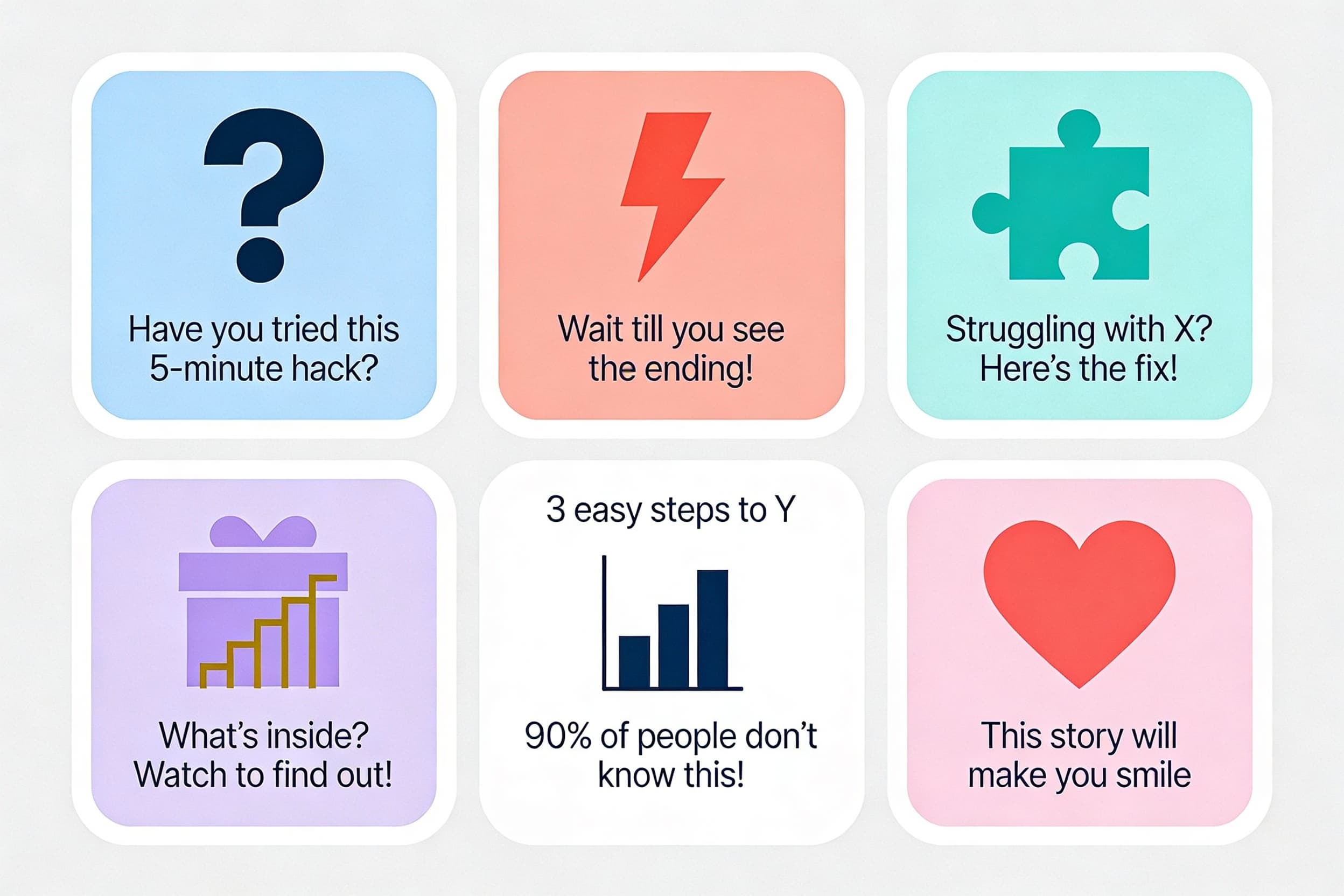
The 7 proven hook types: each triggers different psychological responses in your viewers
Hook Type #1: The Question Hook
A question hook does exactly what it sounds like—you open with a question that your audience either has, or should have.
The magic of a question hook is that it forces engagement. When someone hears a question, their brain automatically wants to answer it. It's not voluntary. It's wired into us.
Question Hook Examples
- "Have you been making this huge mistake with your skincare routine?"
- "What's the one thing nobody tells you about starting a side hustle?"
- "Do you know the real reason Instagram stopped showing your posts?"
When to use it: Educational content, problem-solving content, and anything where your audience already has a problem or question they're looking for answers to.
Hook Type #2: The Shock/Surprise Hook
A shock hook disrupts expectations. It presents something unexpected, counterintuitive, or contradictory to what people normally believe.
Shock/Surprise Hook Examples
- "I saved $10,000 by doing the opposite of what every YouTuber recommends..."
- "This popular productivity hack is actually destroying your productivity..."
- "I lost 50 pounds without ever going to the gym. Here's why..."
When to use it: Contrarian content, surprising tips, and anything that challenges conventional wisdom. Warning: use it authentically. A false shock hook will destroy your credibility.
Hook Type #3: The Problem-Solution Hook
This hook is straightforward. You present a problem your audience has, and hint that you're about to show them the solution.
Problem-Solution Hook Examples
- "Your TikTok videos aren't going viral because of this one thing. Here's the fix..."
- "Struggling to fall asleep? This 2-minute technique actually works..."
- "Your brand is getting zero DMs because you're making this mistake..."
When to use it: This is the workhorse hook. It works for tutorials, tips, life hacks, productivity advice, fitness, wellness, and any niche where people have common problems.
Hook Type #4: The How-To Hook
The how-to hook tells viewers they're about to learn something valuable in the next 30 seconds.
How-To Hook Examples
- "Here's how I went from zero to 100K followers in 6 months..."
- "The exact 5-minute morning routine that changed my life..."
- "How to edit Instagram Reels in half the time..."
When to use it: Tutorial content, educational content, productivity hacks, any content where you're teaching a specific skill or technique.
Hook Type #5: The Teaser/Cliffhanger Hook
A teaser hook hints at something amazing, valuable, or shocking without revealing it.
Teaser/Cliffhanger Hook Examples
- "Wait until you see what happens next..."
- "I've been holding onto this secret for three years. Here it is..."
- "This one thing literally changed everything. Let me explain..."
When to use it: Storytelling, reveals, transformations, before-and-after content, and anything with a surprising payoff moment.
Hook Type #6: The Statistics/Data Hook
Opening with a surprising statistic or piece of data triggers curiosity because it contradicts expectations or seems significant.
Statistics/Data Hook Examples
- "92% of creators are doing this wrong. Here's what they should be doing..."
- "Instagram Reels get 140 billion views every day. Here's how to get some of those views..."
- "Only 3% of creators understand this. You might not either..."
When to use it: Industry data, business advice, trending information, anything where you can back up your content with specific numbers.
Hook Type #7: The Emotional Appeal Hook
This hook starts by acknowledging a feeling your audience has. It shows empathy. It says "I know how you feel."
Emotional Appeal Hook Examples
- "Ever felt completely stuck in your career and thought about giving up?"
- "I wasted three years on this before realizing there was a better way..."
- "Nobody talks about the loneliness of building a business alone..."
When to use it: Personal growth content, mental health topics, business journey content, lifestyle content, anything where there's an emotional journey involved.
The Neuroscience of the First 3 Seconds
Let's get specific about what happens neurologically in those critical first three seconds.
When someone scrolls onto your Reel, their brain doesn't know anything about it yet. It's operating on autopilot. The prefrontal cortex—the thinking part of your brain—isn't even fully engaged.
Then, something happens. A visual change. A word on screen. A sound. A facial expression.
Immediately, your viewer's brain registers a "change" signal. This triggers the attentional network in their brain. Their eyes focus. Their awareness sharpens.
The Power of Multiple Cuts
This attention is fragile—it lasts maybe 1.5 to 2 seconds. This is why 3 or more cuts in the first 3 seconds boost watch time by 58%. Each cut creates a new "change" signal. Each cut makes the brain go "wait, what's happening now?" and resets their attention. It's why Hollywood blockbusters cut as fast as every 2 seconds. It's not arbitrary—it's neuroscience.
The Instagram Algorithm: What Happens After the Hook
Your hook does one job: get someone to watch past 3 seconds. But then what?
Once your viewer makes it past the 3-second mark, Instagram's algorithm moves to the second phase: testing the video.
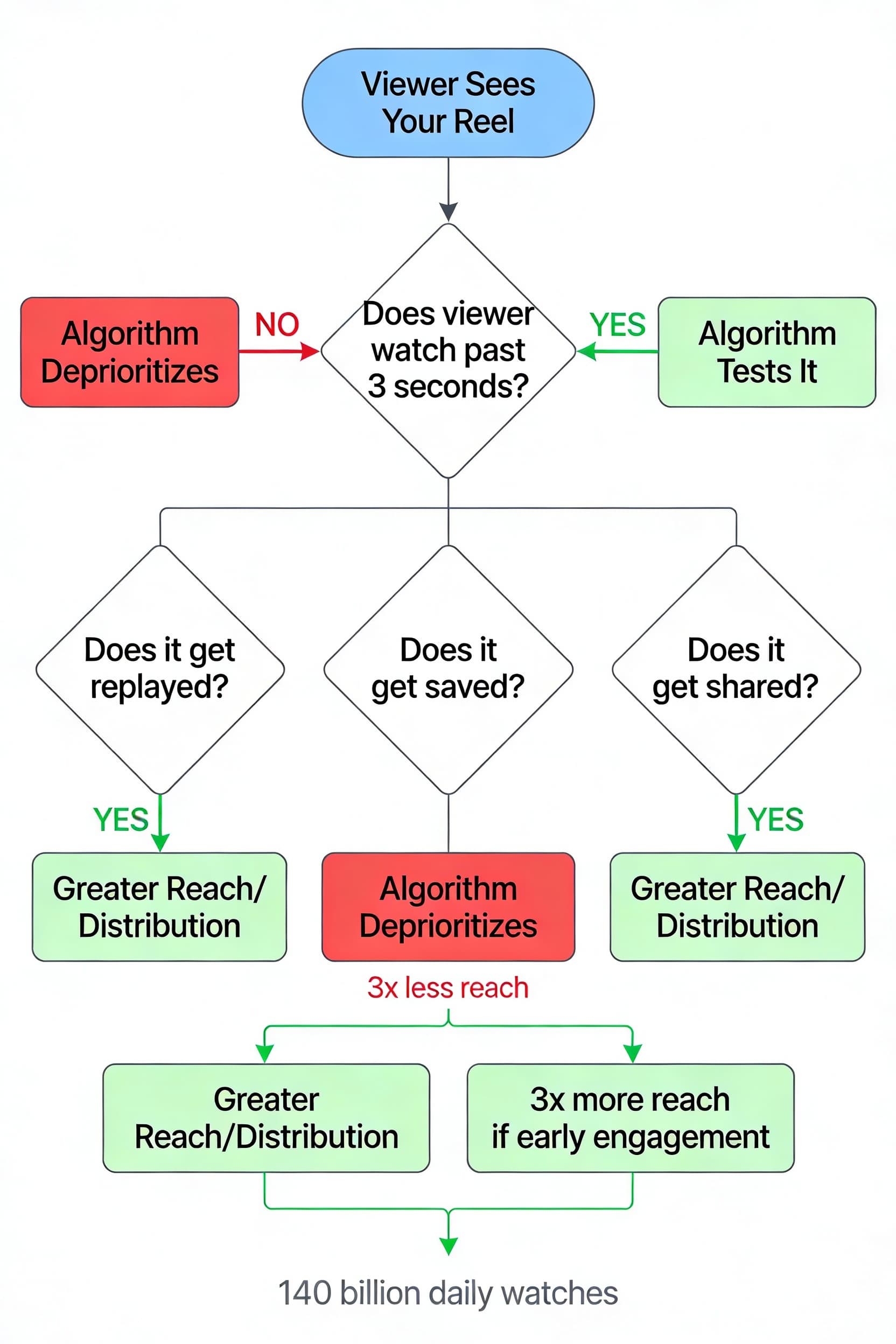
The Instagram algorithm decision tree: understanding what happens after viewers pass the 3-second mark
Here's what Instagram measures after 3 seconds:
Did people watch most or all of it?
Did people watch it again? (Huge quality signal)
Did they save it to watch later or share?
Did they send it to others?
Did they click your profile to see more?
Did they engage in meaningful conversation?
Each of these signals tells Instagram one thing: "This content is valuable. Push it to more people."
The Early Engagement Multiplier
When you create early engagement (within the first hour of posting), reach can increase by 300%. Not 30%. Three hundred percent. Early engagement signals to Instagram that the content is worth promoting, so it gets pushed to more Explore pages. This is why timing your Reels matters.
10 Proven Hook Templates You Can Copy-Paste Right Now
Templates aren't cheating. Templates are how professionals work. They're frameworks that have been proven to work. You fill in your specific context, and boom—you've got a hook.
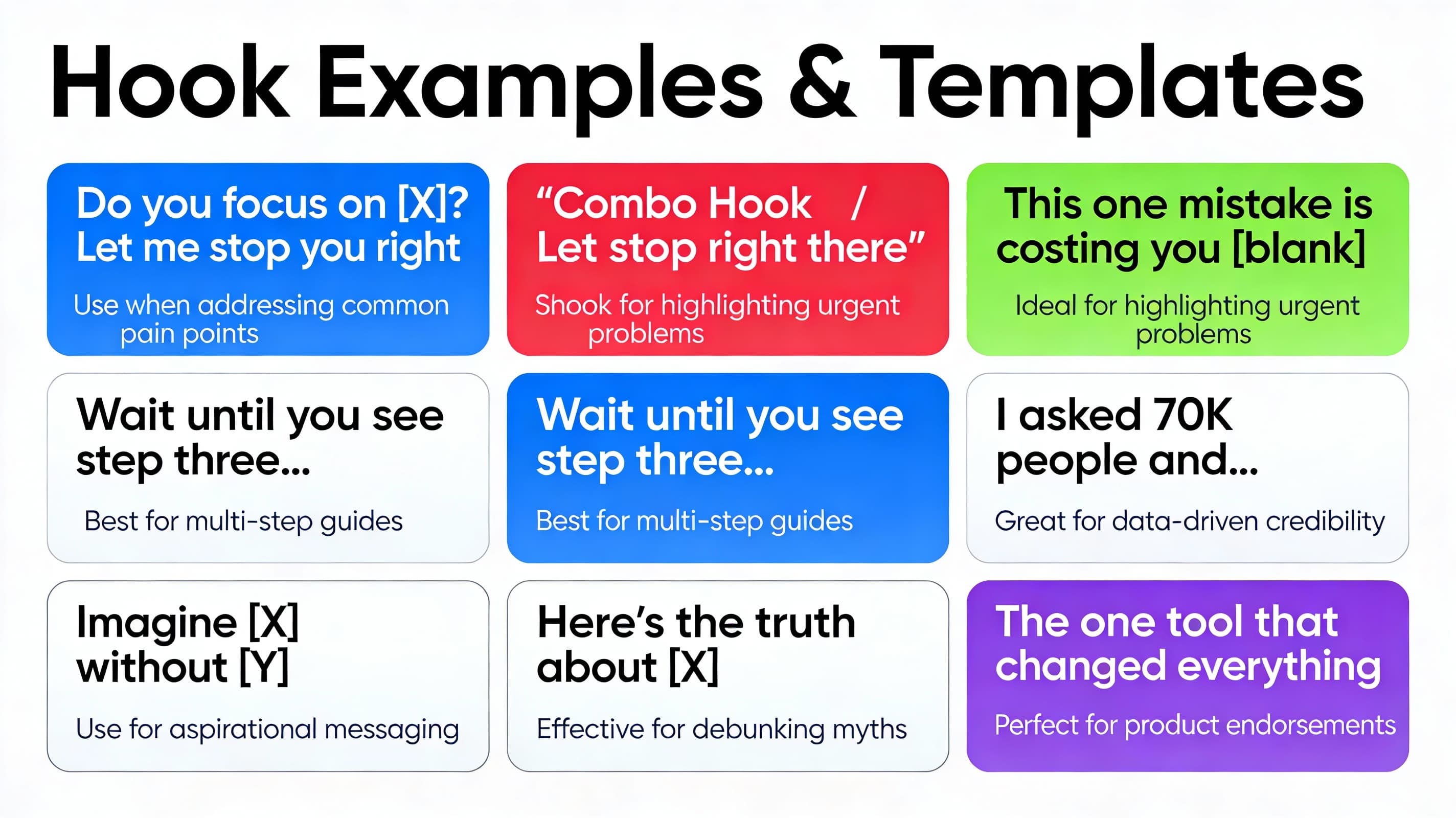
10 copy-paste hook templates with proven results across different niches
#1: The Direct Problem Hook
"If you're [problem], you need to hear this..."
Example: "If you're struggling to grow your TikTok, you need to hear this..."
#2: The Counterintuitive Statement
"Everyone says [common advice], but [contradiction]..."
Example: "Everyone says calories are all that matters for weight loss, but they're ignoring this one thing..."
#3: The Survey Result Hook
"I asked [number] people about [topic], and [surprising result]..."
Example: "I asked 10,000 creators about their biggest mistake, and 89% said they were making the same error..."
#4: The Combo Hook (Question + Problem-Solution)
"Do you focus on [wrong thing]? Let me stop you right there..."
Example: "Do you focus only on vanity metrics? Let me stop you right there..."
#5: The Time-Specific Hook
"I tried this for 30 days and [result]..."
Example: "I followed a new productivity system for 30 days and completed 10x more projects..."
#6: The Feeling Recognition Hook
"Have you ever felt [emotion] because of [situation]?"
Example: "Have you ever felt exhausted because you're saying yes to everything?"
#7: The Before You [Action] Hook
"Before you [action], watch this..."
Example: "Before you start a YouTube channel, watch this..."
#8: The Percentage Hook
"[Percentage]% of people are doing this wrong. Here's why..."
Example: "87% of gym-goers are using this wrong. Here's the correct form..."
#9: The Secret/Reveal Hook
"[Company/Creator/Expert] doesn't want you to know this, but..."
Example: "Instagram doesn't want you to know this, but the algorithm actually rewards..."
#10: The Consequence Hook
"If you don't [action], [negative consequence]..."
Example: "If you don't fix your thumbnail, your video will never get watched..."
Emotions That Make People Hit the Share Button
Not all emotions are created equal when it comes to going viral.
Research on viral content shows a clear pattern: high-arousal emotions drive shares much more than low-arousal emotions.
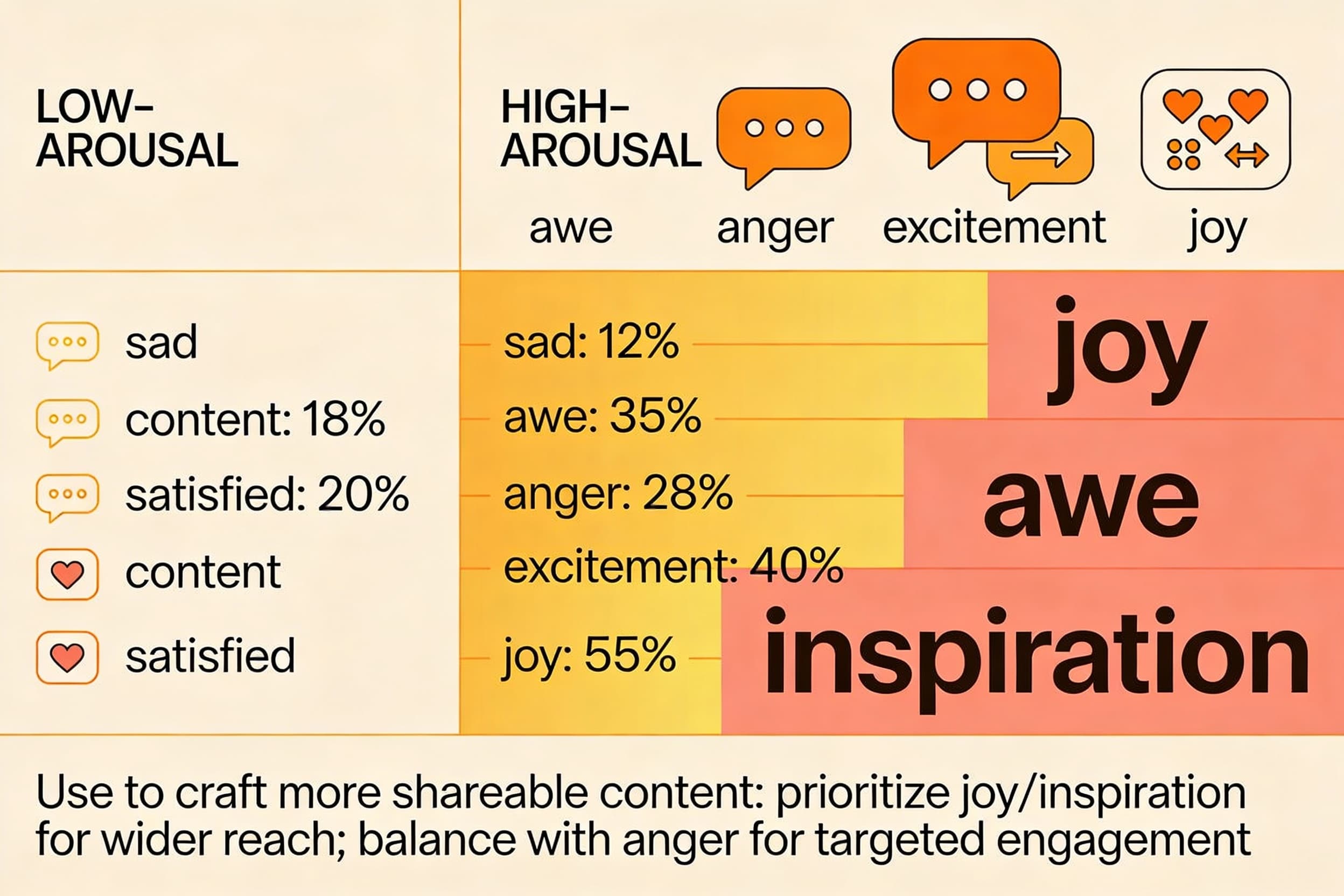
Emotion science: high-arousal positive emotions (awe, inspiration, joy) drive the most shares
High-Arousal Emotions (Drive Shares)
- Awe (wonder, amazement)
- Excitement (energy, anticipation)
- Amusement (laughter, humor)
- Inspiration (motivation, hope)
- Anger (outrage, indignation)
Low-Arousal Emotions (Suppress Shares)
- Contentment (satisfaction, happiness)
- Sadness (melancholy, grief)
These emotions are calming and settling—they don't create the urge to share.
The formula for maximum shareability: high-arousal, positive emotion.
Think about the last video you shared. It probably made you feel something strongly. It probably made you think "I have to show this to my friends." That's the goal.
The Posting Strategy That Multiplies Your Reach
Creating the perfect hook isn't enough if you post at the wrong time. Here's what data shows about optimal posting:
- Midnight posts get highest views: Average 25,000 views per Reel
- 10 PM - 7 AM Saturday is peak engagement time: These Reels get pushed more aggressively
- First hour engagement matters most: Posts with high engagement in hour one reach 3x more people
The strategy: post when your specific audience is online (experiment and check your analytics), then immediately engage with comments, likes, and ask questions in your caption to encourage those first interactions. For more on scheduling and batching content, check out our batching and scheduling guide.
Common Hooks That Actually Fail (And Why You Should Never Use Them)
Not all hooks work. Some hooks are so overused they've become white noise. Others are so misleading they destroy trust.
The Misleading Hook
"Wait until the end" when there's no payoff at the end.
Why it fails: You break trust. Even if some people finish watching, they feel manipulated and won't follow you next time. The algorithm also sees a drop-off and doesn't recommend it.
The Generic Hook
"You won't believe what happens next" with no context of why you should care.
Why it fails: It doesn't create curiosity or emotional engagement. There's no specific reason to watch. Your brain doesn't recognize why this matters.
The False Shock Hook
Claiming something shocking that's actually obvious or boring.
Why it fails: Same as misleading—it destroys trust immediately.
The Negative-Only Hook
Opening only on fear, stress, or anxiety without offering any hope.
Why it fails: While negative high-arousal emotions do get shares, negative without positive context gets fewer shares than positive emotions.
The Psychology of Saves, Shares, and Follows
Different actions mean different things to your audience.
- Likes: "I approve of this"
- Saves: "I want to come back to this"
- Shares: "I need to show my friends this"
- Comments: "I have something to say about this"
- Follows: "I want more content like this"
Each action sends a different signal to the algorithm. Shares and saves are the most valuable signals because they indicate your content is valuable enough for someone to take extra steps.
This is why the best hooks don't just stop the scroll—they make someone want to keep the video forever (save) or send it to someone else (share).
Your 2026 Hook Checklist: Before You Post
Before you publish a Reel, ask yourself these questions:
If not, trim it.
If it seems generic, rewrite it.
If not, it probably won't work.
Does the rest of the Reel deliver on what the hook promises?
Not required, but it helps reset attention.
If it's too complicated, simplify it.
A shock hook works great for business content but might feel out of place in a wholesome parenting niche.
The Future of Hooks in 2026 and Beyond
The fundamentals of hooks won't change. Human brains will still respond to curiosity, emotion, and novelty. But how creators use hooks is evolving.
What's changing:
Authenticity is rewarded more
Overly edited or fake-looking hooks underperform. Raw, real hooks from regular people are crushing it.
Niche specificity matters
Generic hooks work worse than hooks specifically tailored to your exact audience's specific problems.
Emotional storytelling beats pure information
Data and facts are useful, but wrapped in a human story, they're unstoppable.
Consistency builds trust
One amazing hook won't build an audience. Consistent, quality hooks every single time will.
The creators winning in 2026 aren't the ones trying to trick the algorithm. They're the ones who understand their audience so deeply that their hooks feel personally relevant to each individual viewer.
Final Thoughts: The Hook is Your Superpower
Every single successful creator on Instagram right now has one thing in common: they understand hooks.
They understand that the first 3 seconds determine everything. They understand that human brains respond to curiosity, emotion, and novelty. They understand that a great hook isn't manipulation—it's respect for your audience's time.
When you respect someone's attention enough to grab it immediately and then deliver on that promise, something magical happens. They don't just watch—they follow, they save, they share, they come back.
That's how content goes viral in 2026. Not through complicated tricks or secret algorithms. But through understanding the fundamental neuroscience of how humans actually pay attention.
Your Next Step
Stop overthinking your hooks. Start using the templates. Test different types. Track which ones work for your specific audience. Iterate. The path to viral Reels doesn't require you to be famous, to have expensive equipment, or to have thousands of followers already. It just requires you to understand the science behind stopping the scroll.
Now go make something that makes someone stop scrolling. The internet needs it.
Authoritative Sources & References
Research & Data
Related Reading
Want to apply these hook strategies at scale?
Our Instagram Reels Maker automatically identifies the most engaging moments from your long-form content and transforms them into scroll-stopping Reels with optimized hooks, captions, and formatting.
Try the Instagram Reels MakerQuién está detrás de AutoShorts

Nicolai Gaina
Fundador, AutoShorts
Ingeniero de software con más de 12 años de experiencia profesional en el Área de la Bahía de San Francisco. Especializado en desarrollo de software, creación de contenido y crecimiento en redes sociales, destaca en estrategias de crecimiento basadas en datos, IA y herramientas en línea de impacto para creadores de contenido.
Seguir en: LinkedInMás sobre AutoShorts
Artículos relacionados

50 Essential TikTok Hooks That Actually Stop the Scroll
Master the first 3 seconds. Learn 50 proven TikTok hooks organized by category, the psychology behind why they work, and how to test which hooks perform best for your niche.

How to Explode Your TikTok Views in 2026
Stop struggling with 50 views. Master the 3-second rule, watch time optimization, content pillars, and the TikTok algorithm to grow your audience in 2026.

How to Get More Instagram Followers Organically in 2026
Master Instagram organic growth without ads. Learn profile SEO, Reels strategy, posting times, hashtag tactics, and the algorithm signals that drive real follower growth.

The 2026 LinkedIn Playbook: How to Win When Everyone Else is a Robot
Master LinkedIn's authenticity era with strategies for short-form video, algorithm optimization, profile SEO, and lead generation that out-humans the bots.
Analítica de Video Corto: Qué Métricas Realmente Importan en 2026
Descubre qué métricas de video corto impulsan el crecimiento real. Deja de perseguir métricas de vanidad y aprende los KPIs que verdaderamente importan en TikTok, YouTube e Instagram en 2026.
Vídeo de Corta Duración para Equipos de Ventas B2B: De SDR a Closer
Domina el vídeo de corta duración en cada etapa de ventas. Playbook por roles para SDRs, AEs y closers con plantillas de copy y sin necesidad de edición.